

Return to Office Reset: Boundaries & Focus
For a lot of people in the U.S., going back in person hasn’t felt like “getting back to normal.” It’s felt like a full reset: earlier alarms, crowded trains or traffic, constant small talk, and a calendar that somehow stayed just as full as when everyone was remote.
Maybe this sounds familiar:
- You close your laptop at home at 6:30 p.m., then scroll work chat from the couch.
- On office days you leave the house before sunrise, get home after dark, and still feel behind.
- You’re grateful to see coworkers again, but your brain is wiped by 3 p.m.
That mix of gratitude and exhaustion is exactly why return to office mental health has become such a big topic.
A thoughtful return to office reset isn’t about forcing everyone to love the office again.
It’s about designing boundaries, focus norms, and small routines that make hybrid work actually livable.
Recent surveys underline how high the stakes are. The American Psychological Association’s 2023 Work in America survey found that 92% of workers say it’s important to them to work for an organization that values their emotional and psychological well-being, and 77% reported experiencing work-related stress in the previous month. Gallup estimates that U.S. workers who rate their mental health as fair or poor miss nearly 12 workdays a year due to unplanned absences, costing the economy tens of billions of dollars annually.
When you look at those numbers, a return to office reset becomes a mental-health intervention, not just a facilities decision.
Why returning to the office feels so draining
If you’re wiped out on office days, you’re not being dramatic.
A return to office reset asks your nervous system to adapt to several changes at once:
- The commute. Crowded subway cars, traffic, parking costs, or that stop-and-go bus ride where you’re standing, balancing a coffee and your laptop bag.
- Constant social contact. Kitchen catch-ups, hallway questions, small talk before every meeting, and the sense that you need to look “on” even when you’re tired.
- Unspoken expectations. The feeling that leaving “too early” looks bad, that you should say yes to “got a sec?” questions, or that you need to answer emails immediately.
On top of that, many workers are carrying extra load—childcare, elder care, chronic health conditions, or financial pressure. When all of that collides with a return to office reset, your body can stay in low-level fight-or-flight all day.
A helpful reframe is to treat the first months of in-person work like physical training. You wouldn’t go from zero workouts to running a half-marathon every weekday. In the same way, your nervous system needs time to build capacity for noise, social interaction, and commute stress again.
Questions you can ask yourself or your team:
- What parts of office days actually give us energy (shared lunches, whiteboard sessions, mentorship)?
- What drains us the fastest—commuting, noise, meeting overload, or something else?
- If we saw this as a 90-day experiment, what would week 1 look like vs. week 12?
Early signs you’re not coping well
Burnout almost never arrives with a clear label. It creeps in through early warning signs that are easy to dismiss—especially during a return to office reset.
Common early signals include:
- Snapping at tiny things you’d normally let slide
- Brain fog and trouble finishing tasks that used to feel simple
- “Sunday dread” before in-person days
- Changes in sleep or appetite
- Feeling like you’re “quiet quitting in your head,” even if you’re still performing on paper
Maybe you notice that on office days you get home, drop your bag by the door, and just stare at your phone for 40 minutes. Or you wake up at 3 a.m. thinking about something your manager said in passing.
You can use a quick weekly check-in:
| Early sign | Small reset you can try this week |
|---|---|
| Sunday dread | Plan one small thing you genuinely enjoy after work on the next office day. |
| Brain fog | Block 90 minutes for deep work with notifications off and door/headphones on. |
| Irritability with coworkers | Add two 5-minute breaks where you leave your desk and step outside. |
| Trouble sleeping before office days | Prep your bag and outfit earlier; set a tech-off time 60 minutes before bed. |
If these signs keep building, it may be time to treat your situation as a workplace burnout prevention priority—not something you fix by “trying harder.”
Resetting meetings instead of adding more
One of the easiest traps in a return to office reset is using in-person time to pile on more meetings: coffee chats, quick stand-ups, “while we’re all here…” brainstorms. The result is predictable: meeting overload.
Instead, treat meeting time as a limited resource:
- No-meeting blocks. Choose at least one morning or afternoon each week where internal meetings are off-limits. Protect it like you would an important client call.
- Shorter defaults. Set the calendar default to 25 or 50 minutes. Those extra 5–10 minutes are where people breathe, stretch, or refill water.
- Real agendas. If there’s no clear goal or decision, move the topic to email, chat, or a shared doc.
- Camera norms. Decide when cameras matter (e.g., 1:1s, tough conversations) and when they’re optional, especially if people are already sensory-overloaded.
If you’re a manager, you can even model this by declining or canceling meetings that don’t have a purpose. That sends a strong signal that your return to office reset is about focus and respect—not visibility theatre.
Office focus norms for in-person days
Without clear norms, office days can feel like being pecked to death by “got a minute?” moments. This is where office focus norms come in.
Some practical examples:
- Channel agreements. Use chat for short, urgent questions; email for longer, non-urgent topics; and in-person drop-bys only when it truly needs real-time back-and-forth.
- Response-time expectations. Instead of assuming everyone replies instantly, agree on what’s typical (for example, “We aim to respond within the same business day unless it’s clearly urgent”).
- Quiet hours. Choose one morning and one afternoon block where people can mark themselves in deep-work mode—no pings, no drop-bys, no added meetings.
- Desk signals. Headphones on, a small sign, or even a status light can signal “please don’t interrupt unless it’s urgent.”
These hybrid work boundaries protect both productivity and return to office mental health. They also make it easier for introverts, deep thinkers, and neurodivergent teammates to do their best work without feeling rude.
Commute stress and transition rituals
Even a relatively short commute can shrink your day and spike stress. Maybe you live in Queens and work in Manhattan, spending an hour packed into the subway—standing, balancing your bag, mentally rehearsing the day. Or you’re crawling along the freeway in LA, watching the ETA on your GPS creep upward every few minutes.
You can’t always change the distance, but you can change how you transition into and out of work. As part of your return to office reset, try:
- Commute-only media. A playlist, audiobook, or podcast you only listen to on office days so your brain associates it with “we’re shifting gears.”
- Arrival routines. A quick walk around the block, stretching in a quiet stairwell, or 3 minutes of breathing before you open your laptop.
- Homecoming rituals. When you get home, put your phone on a shelf, change clothes, drink a glass of water, and do one small grounding activity—pet the dog, water a plant, or sit on the balcony for five minutes.
These rituals help your nervous system move from “alert mode” into “I’m home now,” which is crucial for managing commute stress and avoiding the sense that your whole life is just work and travel.
Ergonomics and movement breaks
Many people built more customized setups at home: a laptop stand, external keyboard, maybe even a favorite chair. Back in the office, you might be dealing with older desks, harsh lighting, and chairs that were bought years before anyone was working on laptops all day.
Part of a realistic return to office reset is taking your body seriously:
- Basic ergonomics. Adjust your chair so feet are flat on the floor, knees around 90 degrees; raise your screen so you’re not craning your neck. If you can, bring a portable laptop stand or external mouse from home.
- Micro-pauses. Every 30–45 minutes, drop your shoulders, soften your jaw, and look 20 seconds at something far away.
- Walking 1:1s. When the weather and environment allow, suggest a lap around the block instead of another conference-room meeting.
- Movement anchors. Link simple movements to routine tasks: stretch every time you send a big email, do a quick posture reset when you refill water.
These small ergonomic movement breaks might not look like much, but they add up. Reports on workplace health show that musculoskeletal issues and mental health remain leading causes of long-term absence, making physical comfort and mental wellbeing central to performance (Chartered Institute of Personnel and Development, 2023).
Hybrid schedules that don’t blur everything
Hybrid work was supposed to give us the best of both worlds. In practice, without solid hybrid work boundaries, it can feel like you’re doing two jobs at once—office worker and remote worker—on a single salary.
A few structure ideas for your return to office reset:
- Batch your office days. When possible, put them back-to-back so you’re not constantly switching gears. This makes it easier to plan childcare, errands, and therapy or medical appointments.
- Name your remote-focus days. Treat at-home days as deep-work days instead of “overflow” days for meetings. Protect blocks of time for writing, coding, strategy, or analysis.
- Set a real end time. Decide when your workday actually ends. If a message comes in at 9:30 p.m. and it’s not truly urgent, it can wait.
- Be transparent on your calendar. Mark commute time, deep-work blocks, and non-negotiable personal commitments. It helps others respect your boundaries.
Hybrid can absolutely support return to office mental health—but only if there are boundaries between “available,” “focusing,” and “off.”
Talking with managers about limits
You can do a lot on your own, but a return to office reset really works when managers are involved. The hard part is saying what you need without feeling like you’re complaining or “not a team player.”
Some scripts you can adapt:
- “I’ve noticed that on office days I’m in meetings almost all day, so I end up doing focus work at night. Can we look at which meetings I’m essential for and which could be optional or async?”
- “My commute adds about two extra hours to my day. I can manage that if we protect deeper focus time on my remote days so I’m not constantly catching up after hours.”
- “Here’s a list of tasks that really require quiet and concentration. How can we structure my week so those get protected time?”
You don’t have to present a perfect solution. Framing it as a joint problem—“How can we make this return to office reset sustainable?”—invites collaboration instead of defensiveness.
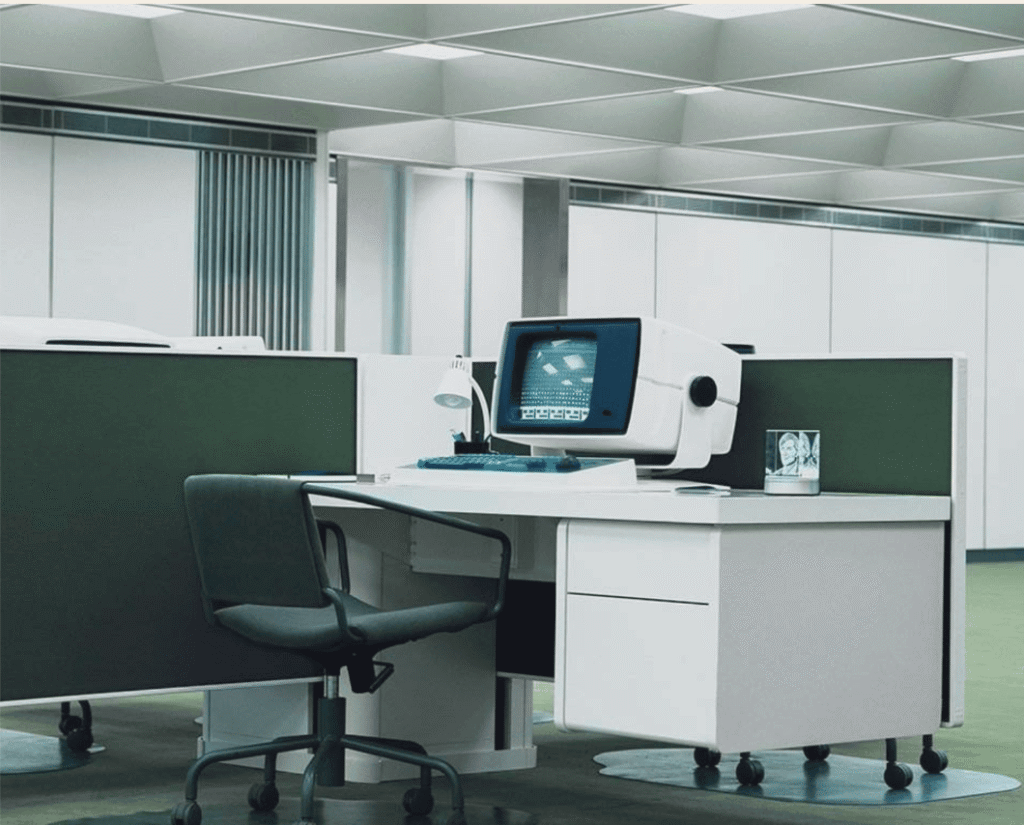
A quiet, old-school cubicle setup—an image of office life before today’s hybrid work norms.
Supporting anxious or neurodivergent team members
A truly healthy return to office reset has to work for everyone, not just people who enjoy open offices and spontaneous conversations. Colleagues with anxiety, ADHD, autism, sensory processing differences, or chronic health issues might experience back to office anxiety much more intensely.
Small but meaningful adjustments can include:
- Predictability. Publishing office days, meeting rhythms, and expectations in advance. Surprises are hard on everyone but especially on anxious or neurodivergent nervous systems.
- Sensory options. Quiet rooms, permission to wear noise-canceling headphones, or the ability to choose a seat that works best (not directly under an AC vent or bright light, for example).
- Clear communication. Follow verbal discussions with written notes. Clarify priorities instead of assuming everyone will infer them.
- Choice in participation. Let people contribute in chat, by email, or asynchronously when that’s more comfortable or accessible.
Workplace wellness research from Mental Health America’s Mind the Workplace project shows that employees thrive when their identities are acknowledged and valued, and when leaders actively create inclusive, psychologically safe environments (Mental Health America, 2023). Building flexibility into your return to office reset is part of that inclusion.
When to bring in professional help
Sometimes small changes aren’t enough. You might need support beyond scheduling tweaks and new habits—especially if:
- You’re experiencing panic attacks or intense back to office anxiety
- Your sleep is consistently disrupted by work worries
- You feel hopeless, numb, or unusually tearful for weeks at a time
- You’re reliving past trauma that gets triggered by certain people, locations, or situations at work
A therapist can help you sort out what’s purely work stress, what might be part of anxiety, depression, or trauma, and what realistic options you have. They can also help you plan difficult conversations with managers, HR, or family members, and support you in setting hybrid work boundaries that actually stick.
Guidance from public-health agencies emphasizes that workers want healthy, supportive cultures—not just self-care tips—and that investing in mental health support pays off in productivity and retention (U.S. Department of Health and Human Services, 2022). A well-designed return to office reset often includes professional mental-health support as part of the plan.
Ready for a Healthier Return? Talk With a Therapist Who Gets It
A return to office reset doesn’t have to mean pushing through exhaustion or pretending you’re fine. It can mean:
- Redesigning meetings so they protect, rather than drain, your attention
- Setting office focus norms that respect deep work and real rest
- Reducing commute stress with small but powerful transition rituals
- Building in ergonomic movement breaks so your body doesn’t pay the full price of desk work
- Treating workplace burnout prevention as a priority, not an afterthought
- Asking for help early—before things become a crisis
If you’re reading this and thinking, “I can’t keep doing it like this,” you’re not the only one. Many people are quietly struggling with return to office mental health challenges and wondering if it’s just them. It isn’t.
Build Your Own Return to Office Reset With Sessions
You don’t have to figure this out alone. Therapists and mental-health professionals at Sessions understand hybrid work, burnout, and back to office anxiety in real-world, high-pressure environments.
Whether you’re:
- An individual trying to make office days survivable again, or
- A leader who wants a healthier, more sustainable return to office reset for your whole team,
Sessions can help you design boundaries, routines, and coping strategies that fit your actual life—not an idealized version of it. Reach out today to start building a workweek that supports both your career and your well-being.